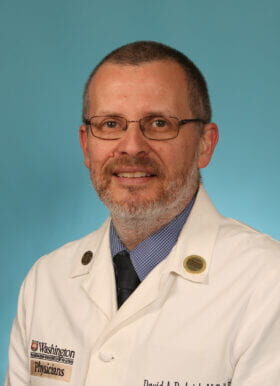
David A. Rudnick, M.D., Ph.D. [ contact information ]
Assistant Professor
Dr. David Rudnick went to University of Illinois and then
completed M.D. and Ph.D. studies at Washington University School of
Medicine. His Ph.D. thesis, done in Dr. Jeffrey Gordon's lab,
focused on understanding the enzymatic reaction mechanism and
substrate specificity of protein-N-myristoylation. He received the
Morris Alex Prize, the Needleman Pharmacology Award and the George
F. Gill Prize in Pediatrics during his medical school education.
He finished a residency in Pediatrics at St. Louis Children's
Hospital. After his clinical training in Pediatric
Gastroenterology and Nutrition, he began working with Drs. David
Perlmutter and Louis Muglia on investigating the molecular
mechanisms of liver regeneration in animal models of pediatric
liver diseases. He joined the staff of our division with an
NIH KO8 Award and an AGA Research
Scholar Award. His lab focuses on studying mechanisms of liver
regeneration.
Dr. Rudnick has shown that prostaglandins, specifically those
derived from COX-2, are required for the initiation of liver
regeneration, and function via a signaling pathway that appears to
be distinct from the TNFa /IL-6/STAT3-dependent pathway. The lab
uses knockout mice in the partial hepatectomy model system as well
as state-of-the-art functional genomics and proteomics to further
examine the initiation of liver regeneration as well as to begin
to define the signals involved in the precise termination of liver
regeneration after restoration of the appropriate liver to body
weight ratio. Lessons learned about liver regeneration in the
murine hepatectomy model system are being applied to other models
of hepatocyte proliferation, including animal models of metabolic
liver disease and hepatocyte transplantation, to begin to dissect
the similarities and differences in the signaling pathways that
regulate the proliferative response in these different settings.
Clinical experience suggests that it is derangement of the hepatic
regenerative response in the setting of chronic liver injury that
can lead to cirrhosis or hepatocellular carcinoma. Understanding
the signal transduction pathways that modulate the hepatic
regenerative response in greater detail may ultimately lead to the
design of novel therapeutic interventions to prevent or even
reverse these outcomes.
|